
Reflecting on connection in an AI-driven world
By Kate Vanskike
As a mid-career (okay, inching toward “later career”) professional, I find myself thinking about relevance. It could be part mid-life discovery – a term I prefer over the more traditional “crisis” – and part reaction to a world changing so rapidly to adjust to the impact of AI and digital living as a whole.
I’m a communications professional. Seasoned in storytelling, magazine production, and content strategies. A writer, editor, storyteller at heart, who also nerds out on metrics. Today’s environment for such things focuses more on the latter, and demands for the former come with more specific expectations and quite a bit more urgency.
The speed of change has me spinning a bit – not because I’m unwilling or incapable of adaptation, but because I feel an inner urge to stop and ponder what’s going on.
Stories well told have incalculable merit. They can live in people’s memories for ages, conjuring up feelings and connections from the distant past and placing them right under one’s nose again. Tales of courage and fear, triumphs and loss, joy and self-deprecating humor are worth sharing not because of the engagement they might receive on social media or the click-through rates they achieve in a mass email, but because they have long-lasting power. They plant seeds of recall that will inevitably touch something deep within.
I wrote for Providence Sacred Heart Medical Center (and Providence Health Care more broadly) for 15 years. I learned to interpret and explain complex medical terminology and retained a vocabulary I’m not sure I can put to good use anymore, unless someone I know ends up needing an endoscopic retrograde cholangiopancreatography. Yeah, I’ve never forgotten what “ERCP” stands for.
Along with now seemingly useless technical jargon (is ERCP still around?)I have memory full of incredible people stories. The young sisters diagnosed with cancer mere months apart and their mother who has PTSD from their hospital stays. The man who underwent surgery to offer a healthy kidney to a stranger who needed one. A model-train engineer who was pinned inside his car by a tree falling in a windstorm. The families whose gifts of organ donation turned crises into hope for other families.
Those stories were saved on hard drives instead of in the cloud, printed on old-fashioned paper, and shared through snail mail. I don’t have any statistics on how often those pieces were torn from the magazine and taped to a refrigerator door or clipped and mailed to a new recipient.
More recently, pieces developed for Gonzaga University – another organization I love for its human impact – begin with the notion of connecting before I think about the modern needs like SEO and keywords and whether the headline is the same as the URL and how we might ensure readers will give it as much as 20 seconds before moving on.
If striving for a 60-second stay on a page isn’t humbling for a writer, I don’t know what is.
My team still pours its heart into features about students who are over-the-top impressive and driven and still optimistic about the world and how they can impact it for good. We still happily share about graduates who are not just excelling in careers but demonstrating lives of purpose and meaning. We share about the generosity of donors who care about the impact of these people on the world.
These are worthy of writing and publishing. But as a content strategist, I often think about the comparison of these pieces to the previous ones – not because one person’s story is better than another’s, or because the medical genre is more interesting than the higher education sphere, but because our contemporary audience is overwhelmed and overstimulated. Breaking through the clutter and making a real connection is harder than ever, despite how quickly and how many methods we can use to pursue it.
As an avid reader, I think about those issues as the recipient of stories as much as from the lens of the producer. In the nonfiction world, I criticize pieces that don’t “get to the point” quickly enough or have a clear call to action. In the fiction realm, I find myself speedreading through pages that I think lack relevancy to character development or plot mastery. Is this because I now have ADD like most in our culture or because I’m expecting everything to move fast? So I can hurry up and … what was I going to do next?
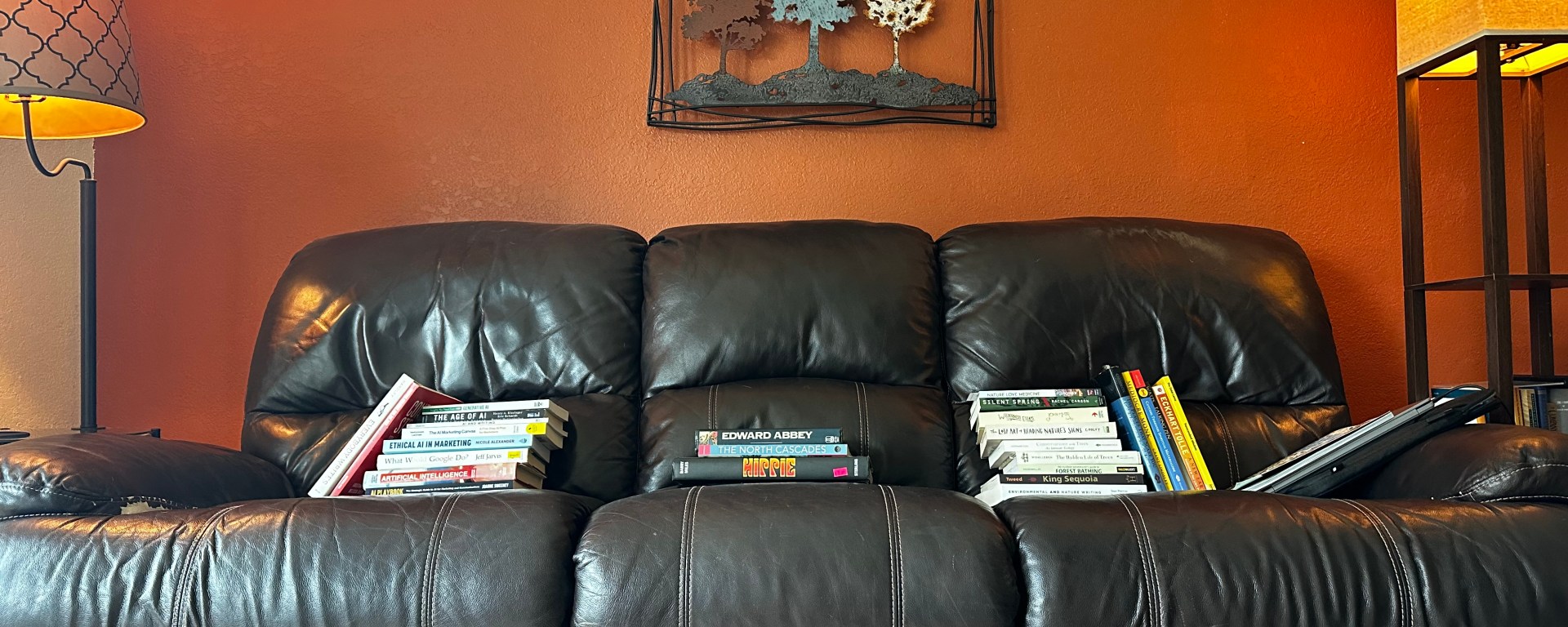
Meanwhile, my husband – also a communications and content strategy pro – is soaking up every opportunity to learn about and master AI in our field. He’s taking courses and teaching classes on his end of the couch while I’m on the other end, burying my limited attention in books about forests and mindfulness. We both have the same goal of writing powerful, human stories, but one of us is boldly forging into the future while the other is trying to escape it.
Which brings me back to this whole notion of finding relevance. I have 8-10 more years before retirement can be a reality (unless I manifest a winning lotto ticket) and I definitely desire for this final decade to be full of purpose and meaning. The question is whether there’s equal balance or a tipping of the scales more in the direction of the algorithm gods.
I haven’t discovered the answer. So if you think you have, let’s connect. You share your mid-career insights and I’ll provide the explanation of endoscopic retrograde cholangiopancreatography.


Oh my word, oh my word!
As a fellow lover of words, smells of the printed page and soaking up stories of things with heart, soul and depth, this touches me to the core!
We strive to hang onto the past treasures yet stay open to the possibilities and that puts us on a mental see-saw, something else that brings “a what??”
LikeLiked by 1 person
Very true… let me hurry up and get things done so I can… what was I doing???
LikeLike
As a casual writer who loves a good story, I felt compelled to “comment.” The tension you’re describing feels real, but I keep coming back to the idea that as long as the human condition exists, storytelling will have an audience. Connection between a writer and a reader isn’t something an algorithm creates; it’s something people like you create, and readers come looking for it.
I see AI less as a threat to that and more as a tool, one that handles the scaffolding so the craftsperson can focus on the actual craft. The irony is that writers with your depth, your archive of real human stories, and your instinct for emotional truth are exactly the ones AI elevates rather than replaces. It’s genuinely bad at the thing you’re best at.
Mindful, intentional adoption of AI doesn’t feel like a compromise to me — it feels protective of what you value most. Less time wrestling with SEO and URL structure, more time with the books about forests. The attention market is noisy and it’s not slowing down, but people are still out there actively looking for writing that makes them feel something. Your work does that. The audience finds its way to the writers who are worth finding. 🙂
LikeLike