
By Kate Vanskike
When I packed for a summer in Chad, a landlocked country bordering the southern expanse of the Sahara Desert, I packed what I thought was a lot of film: 8 rolls of 24 exposures each, 400 speed in the automatic Nikon and 100 speed for the old Canon manual SLR.
By today’s standards, snapping digital pictures by the second with no regard for “wasting film,” a whopping 192 potential photos for an 8-week excursion would not suffice. In 1994, every frame for that first experience on the African continent would mean something. The cost of paying for development would be nothing in comparison to the value of the images of my time there.
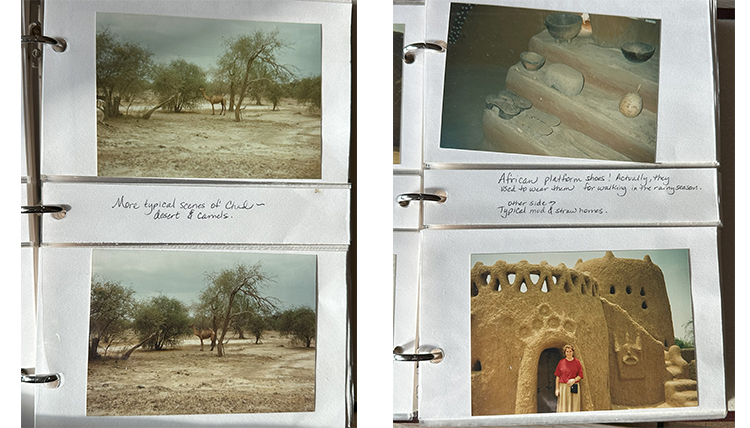
To my dismay, I returned to the U.S. with only 7 rolls of film to develop. When I dropped them at the photo company for processing, I wondered what scenes would remain only in my memory.
After the painful seven or eight days of waiting to see my photos, to shuffle through them quickly and then slowly, the finding was a heartbreak. The missing roll had photos from “the bush.”
Going to “the bush” was surreal for many reasons. The first of which being the simple mystery of “the African bush” conveyed to me by the best of National Geographic and PBS documentaries. The second aspect being my journey to the bush to see it for myself.
By journey, I don’t mean the flight from St. Louis to New York, or JFK to Paris, or Charles de Gaulle to N’Djamena – though I certainly have tales about each landing. No, I mean the daylong journey from Chad’s capital city to a tiny village called Balanyere. This was a real planes-trains-and-automobiles kind of trip.
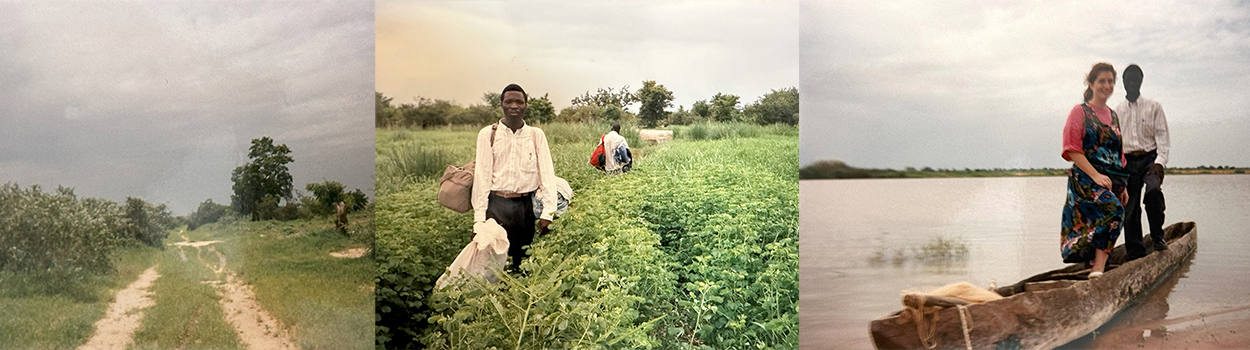
In the morning, my supervisor, David, a linguist with the Society of International Linguistics, would pick me up from the organization’s guest house in a white Toyota 4×4 — the standard vehicle for Chad, it seemed, and we’d head southeast from N’Djamena. The two-lane road cut through a barren landscape, dotted by camels and huts with thatched roofs. And then it became a single pathway of brown ruts in tall green grasses, the welcome sign of “the bush.”
Then David turned off the Toyota’s engine, parking right there in the path.
“And now we walk,” he said, grinning.
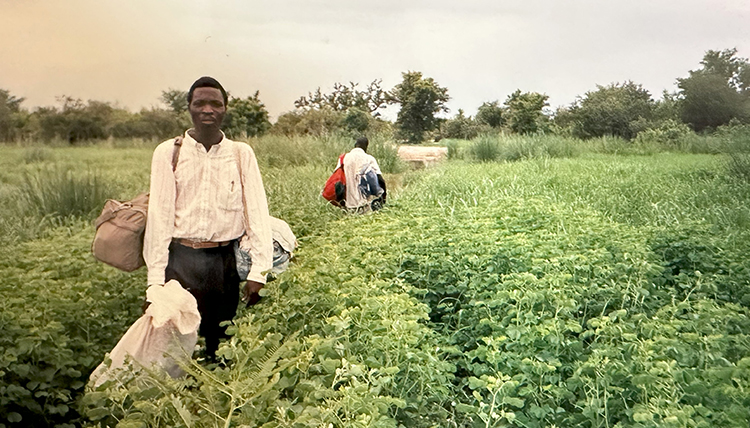
We gathered the bag I’d packed for my weeklong stay, plus items David brought from the city to two missionary women hosting me, and we walked where the truck could not pass. I have no recollection of distance — I only know that as I headed into the unknown, clad in an ankle-length flowery cotton dress and sandals, I wore a smile that stretched across my face.
My old journal fills in a few more details from the day: “We walked through a swamp and prayed there would be no leeches, and once we were through, we walked 2km through the bush.”
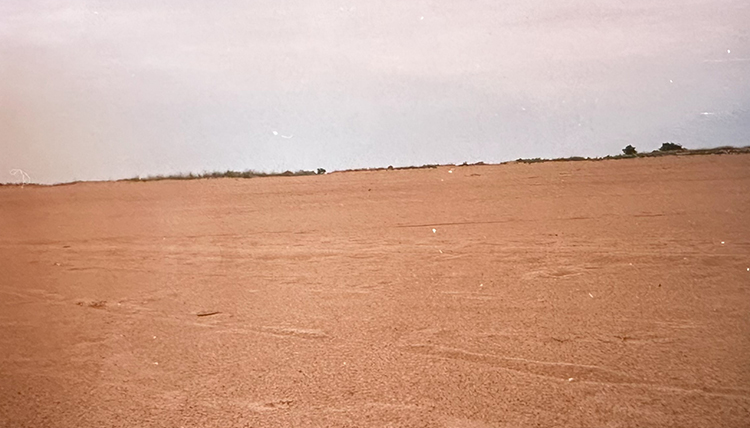
At last we came through the tall rushes and stepped onto the sandy bank of the Chari River. Here, I scooped up some of the coarse, red sand of the southern Sahara and poured it into an empty film canister. A man stood with the long pole of his dugout at the water’s edge — the next mode of transportation for my adventure.
Once sitting inside the canoe — marveling at the hand-carved grooves — I put my hands over the edge of the boat and began tapping my fingers on its exterior. Just a rhythm that came to mind, an accompaniment to my movie-like adventure, I thought. But David, sitting in front, turned back to me quickly: “Don’t attract the hippos,” he said seriously.
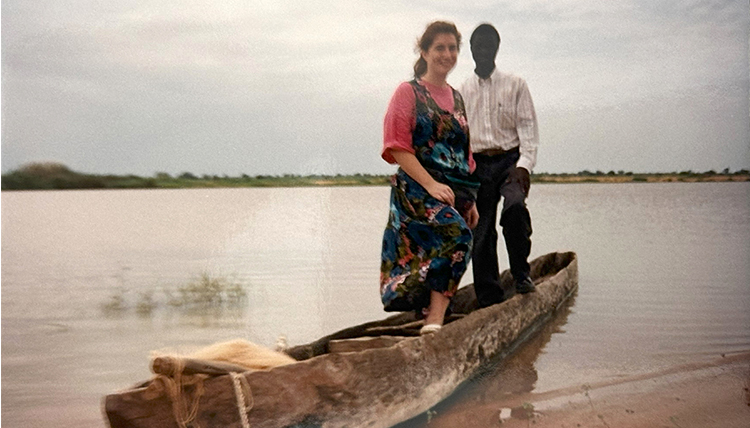
Message received. I put my hands in my lap and admired the bluffs on the approaching riverbank. Cumulus clouds dotted the blue sky over Balanyere, the small community atop the bluff. At the river’s edge, men and boys cast broad nets and women carried their laundry in baskets on their heads. A postcard image burned in my mind.
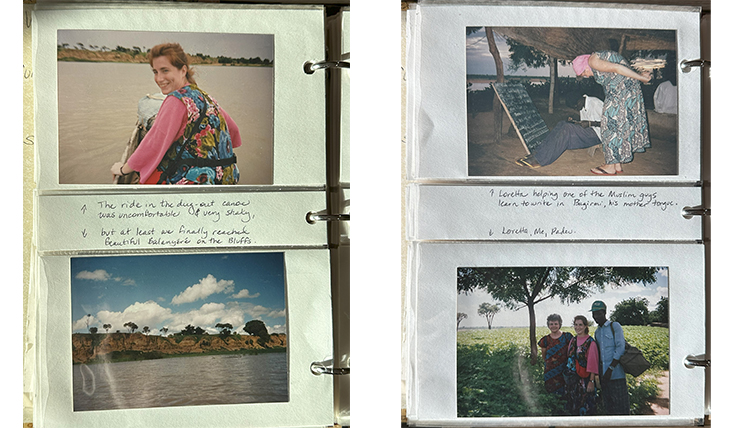
When we reached that bank, we scrambled up the embankment, along a pathway winding through family dwellings of simple huts. Around a few turns and a little further down the river, we arrived to greet my hosts Loretta and Allana, one British and one Australian. David would enjoy just a short visit before he needed to embark on the return trip, ensuring he had enough daylight.
The missionaries had a home constructed of concrete, a roof of metal, and a covered porch. Just out from their entrance was a separate abode — a yurt for guests like me. The main house had electricity (sporadic as it was) but neither accommodation had plumbing. There was an outhouse for such needs.
Over the course of my week in the bush, I watched the missionaries do language work with community members, walked with them through the fields and shared hot tea during midday breaks among the workers who undertook the back-breaking swinging of a hoe to break up the dry, hard soil. I wanted to soak up every detail, and asked if I could go for walks alone. At first, they sent a young boy with me, who forged ahead with his machete, whacking back any overgrowth on the path.
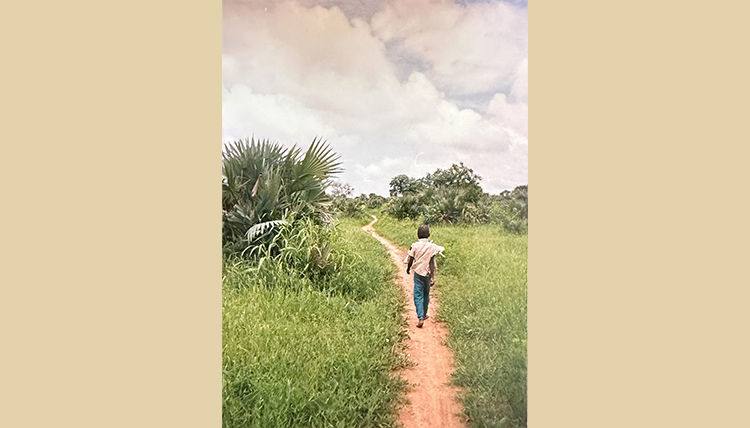
On another day, they agreed to let me go on my own, so long as I kept the river in view. That day, the clouds were dark grey and as they rolled past, a wind whipped up, blowing both my long, auburn ponytail and the skirt at my ankles. I can sense it now like then: the smell — a distinct mix of heat and wildness and foreboding. I stood still and faced the wind and felt it surround me — the spirit in the wind. Ruah. Pneuma.
My Greek and Hebrew language studies came alive to me at that very moment as I recalled that “ruah” in Hebrew means wind and spirit and breath, as the Greek’s “pneuma” also brings together wind and spirit and breath. I felt it.
I felt that the wind indeed was spirit and breath, and more specifically, the spirit or breath of God.
It was a reassuring sensation I would need to recall in the nights and weeks to come. When the spiritual oppression — dare I say “evil” — could be felt in the stifling air and nightmares kept me awake.
But for this moment in the bush, it was a tiny taste of what I might consider enlightenment to be like. A second of holiness.
I heard noises which my imagination turned into wildlife from a safari and I turned to follow the river back toward the village. Ah! My camera! I remembered. I unstrapped its leather lens cover and turned to take photos in all directions – mementos of an unworldly experience not to be trapped inside my brain.
The wind died down as quickly as it had arisen and the sky drawing darker pulled me back to the simple comfort of my yurt.
Several weeks later, after the reverse adventure down the bluff, across the Chari, through the grasses and along the highway back to the city, I’d depart the African continent 22 lbs lighter than when I arrived and eyes opened to spiritual realities my own soul lacked the ability to process. After tearful hugs with my parents, a healthy dose of pizza, and a week of sleep, I took those 7 rolls of film to the developer.
There are no photos of my day in the bush where Ruah and Pneuma called forth my attention. No pictures of the tree where I stood soaking in the universe.
It’s been 30 years of disappointment that — of all the rolls of film to be lost, it had to be this one.
But at last, I’ve had enough encounters with the spirit of the wind, moments that take me right back to the bluffs of Balanyere, that I am okay without the photos. I am grateful to have had the experience at all.
Even though I can’t be certain of the line between memory and imagination, I know in my bones that there on the banks of the Chari River, I dipped my toes into another reality. One that refuses to be captured on film.
 wordsncoffee
Photos cannot capture some experiences because they are more about one’s feelings and understandings than about how a place looks.
LikeLiked by 1 person
So beautifully written and designed…. Such a wonderful week along the Chari River in Chad.
When you shared about your tapping your hands on the dugout canoe, I knew JUST what was going to happen next before I read your words! I wasn’t smart enough to know that the rhythm you were playing would anger the hippos; our guide was warning me, and I passed on the message to you.
I don’t know if it was my imagination or if I really saw it, but somewhere around us, I thought I saw a hippo’s eyes and nose peek out of the water just after you stopped.
And we are still here today thanks to his warning… to remember a week in time we hardly knew would bring back such joy in the summer of 2025.
Thanks so much for taking the time to write this.
Gratefully,
David Faris
LikeLiked by 1 person