

For those of us Vanskike relations lucky enough to spend our childhoods on our grandparents’ farm in rural Missouri, Gramma and Grampa are central figures in our stories of growing up. Perhaps over the years, we’ve romanticized the memories, and maybe we never factored into our tales the reality that Gramma and Grampa were ordinary humans who encountered the same challenges we have, just in different places and times.
Personally, I think G&G would be okay with our romanticizing. I mean, it was Grampa who penned the love letters we have copied and photocopied and shared as if they were written to the world. The lines of those letters are lures back to the land Harold and Ferrel loved before they were Gramma and Grampa, before they became Mother and Dad. The moonbeams that danced in her hair on the paper of his cursive late-night writing – they tease me back to the 1930s of Fergus County, Montana, where tiny towns dot a landscape of fields surrounded by low mountains and long buttes.
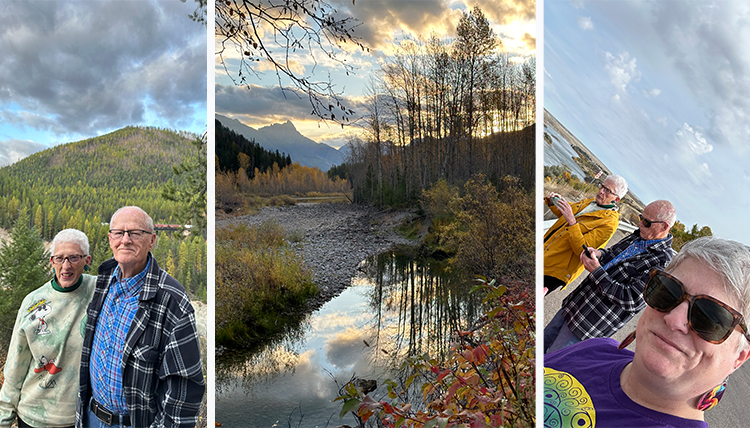
And that’s how I came to hit the road in 2024 with two of Harold and Ferrel’s kids – Sharon and Tom – to roam the backroads and wander through the many farming communities of Central Montana.

Denton, Montana
1932: Resting in a bunkhouse after a long day on the ranch, Harold sat and penned one of many testaments to his love for the curly-haired Byrer girl who stole his heart. They were less than 50 miles or so apart, but with his work and the slow travel on country gravel roads, they might as well have been separated by nations.
And so we three – Tom, Sharon, and I – set off from Lewistown, along the Judith Mountains and inbetween the North and South Moccasin Mountains, cruising over low rolling hills to Denton. Remaining from an era gone by was the standard grain elevator, and a few weathered wooden buildings on main street amid a few more contemporary structures. I wondered whether the post office or the grocery store might have a postcard to take as a souvenir. To my surprise, there were small wooden plaques with the “cityscape” burned on to them, and the words “Denton Strong.”
Apropos. “Denton Strong” must have sustained Grampa on those lonely nights he dreamed of being with his love.
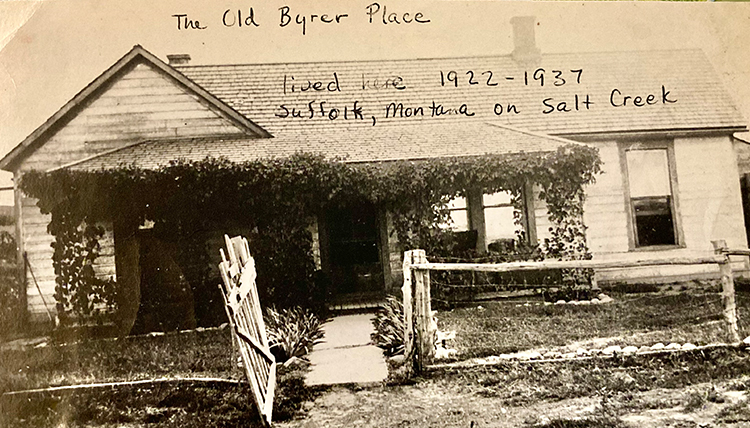
Suffolk, Montana
1932: Here, a woman entering her own roaring 20s received those love letters. She must have stood outside on warm summer nights, looking up at the same moon as her man, reading and re-reading his tender notes. Poor as the family was, Ferrel made herself stylish clothes and practiced poses reflective of the Hollywood stars - poses she’d use in years ahead with her handsome husband.
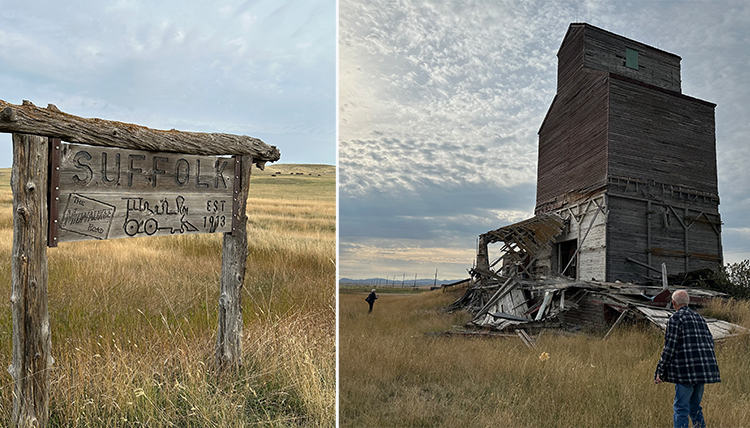
In our October 2024 visit, Suffolk was marked on the road by a wooden sign claiming its establishment in 1913 (the year of Ferrel’s birth), and a large once-red grain elevator, this one more iconic than the last. We wandered its perimeter, listening to the mooing of the cattle on the hill, peering into windows of the office for the elevator.

Across the highway, what remains of the town are a handful of homes – most of which appear to be only partially renovated or updated versions of their original century-old construction. One appears to be an old trading post, complete with a hitching post for tying up horses. A white building still bears the name “Dance Hall” and we could envision a town alive with music and laughter – our own blood playing mandolin, banjo, and drums.
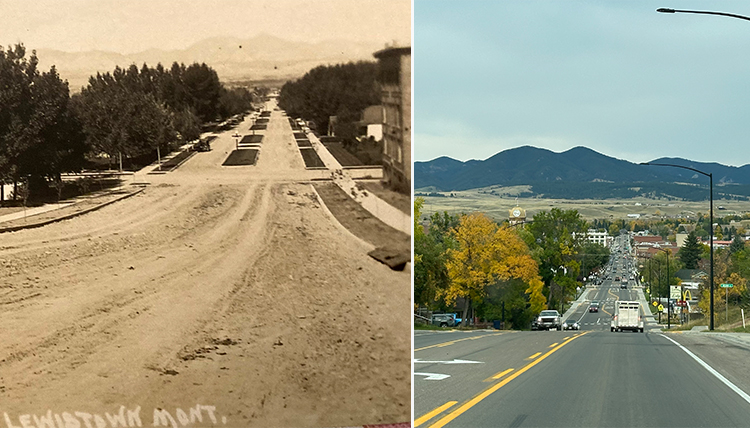
Lewistown, Montana
1935: Nestled in a valley between hills and the Judith Mountains to the north, Lewistown had the modern conveniences of a bustling town: banks, feed stores, hotels, eateries, boarding houses, churches, even a library. At the home of a pastor, Ferrel and Harold exchanged their vows: Simple country folk looking radiant as ever and lucky in love.
We three dropped our things at a hotel and set out to walk somewhere for dinner. But before eating, we needed to pop inside the old Carnegie Library for the smells of old books and worn wooden fixtures. A handwritten sign on a door said “Genealogy,” and we stepped inside. Opening drawers of the old card catalogue system, we found proof of our dear one’s ties. Grampa’s funeral notice (full of errors, but still intriguing, given his departure from the town 50 years earlier), and his sister Doris’ wedding announcement. It was an unexpected delight, to know they were remembered here.

We drove up and down streets searching for anything that resembled a Baptist Church where Gramma was photographed in the snow, or potentially a boarding house where she and the two older kids – Dee and Rosalie – stayed while Gramma awaited the birth of Tom. We found neither. But we did see the hospital where the two girls had been born and where that baby boy arrived that winter of ‘43, when the postman delivered news to Harold in the country, that he had a son. And directly across from our hotel was the Fergus High School where Harold attended for two years and his sisters graduated from. We ate dinner at the former central feed store, where, no doubt, Grandpa had purchased goods. And the next morning, Gramma bade me a good morning through the wafting smell of cinnamon rolls at the coffee shop.

Moore, Montana
1940s: This burg on the outskirts of Lewistown, back before WWII, was a bustling social spot, complete with a women’s center, schools, the perfunctory Western taverns, and even a red-light district. But the first thing one notices when passing by on Hwy. 87 are the grain elevators mere feet from the railroad tracks. This is where Grampa came with his grain, ten miles or so from his farm, which they called the Rock Creek property. Down the gravel Crystal Lake Lane, past dozens of farms, Rock Creek was as picturesque a farm as one could imagine.Gentle hills, small barns, a sturdy square two-story home, and a dozen or so tall trees, some which swept their leafy branches along the ground.
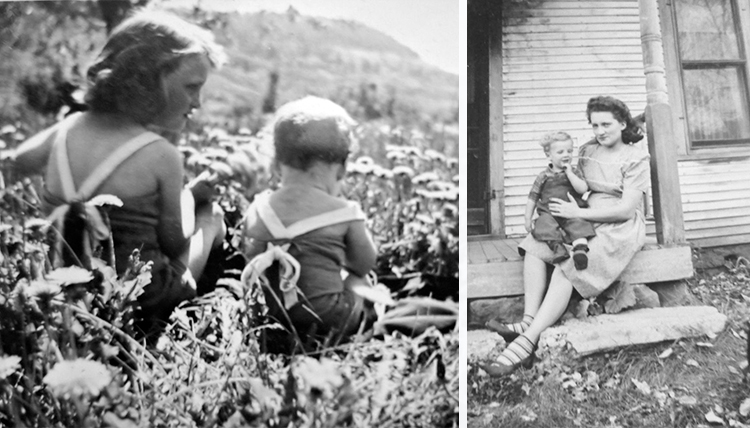
Here, schoolgirls Dee and Rosalie danced in summer and rode tobogans in the winter, and got chased by chickens on the way to the outhouse. Little Tommy, around age 3, got a swift kick to the head by a horse, and Grampa carried his limp body in to Gramma before they rushed toward Lewistown’s hospital. They stopped at the one-room schoolhouse on the corner to tell Dee and Rosalie - and likely Miss Charlotte, the teacher who later became Aunt Charlotte, thanks to Gramma’s match-making with her brother Dyme.
All these stories were rumbling about when Dad, Sharon, and I traversed the countryside toward Rock Creek, Sharon becoming increasingly nervous that the house might be gone. We discovered along the way that the farms toward Rock Creek were all inhabited by Amish families, and one of them had made a home out of the old schoolhouse.The farm property we referenced was indeed still there, a friendly woman told us, and no one would be there.
No one was there, and the house stood tall, bearing proof that it had been cared for and improved upon over the years. Unfortunately, a green metal swinging gate next to an iron fence blocked access to the pathway to the home, at least for Dad and Sharon. For some reason, I asked permission to climb over the gate; Dad said sure and Sharon noted there was no “no trespassing” sign, and so over it I went, taking photos from every angle, and capturing videos of the cacophony of birds chirping away with delight. I made quick work of it, despite desperately wanting to sit on a stump and take a deep breath and wait to feel Gramma and Grampa’s presence.
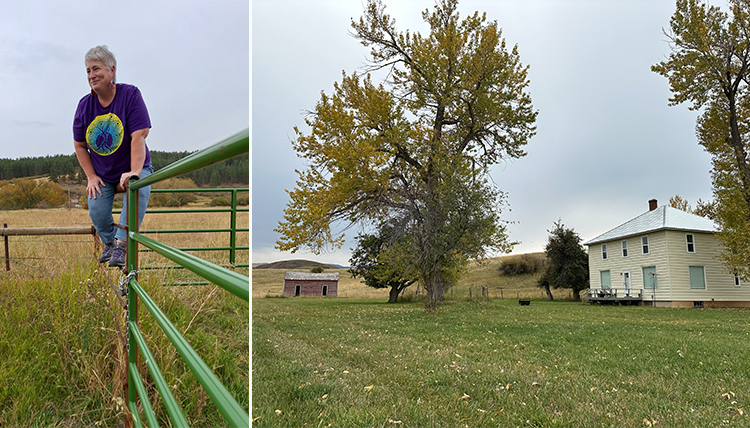
Back in the car, we drove a bit further down the road toward the location where the Crockett Place once sat. It would be home to the Vanskikes for just 10 months before they loaded their lives into the big farm truck and drove to Missouri. No signs of the homestead remained, but the cows in the pasture by the cute farm with a creek looked pretty content.
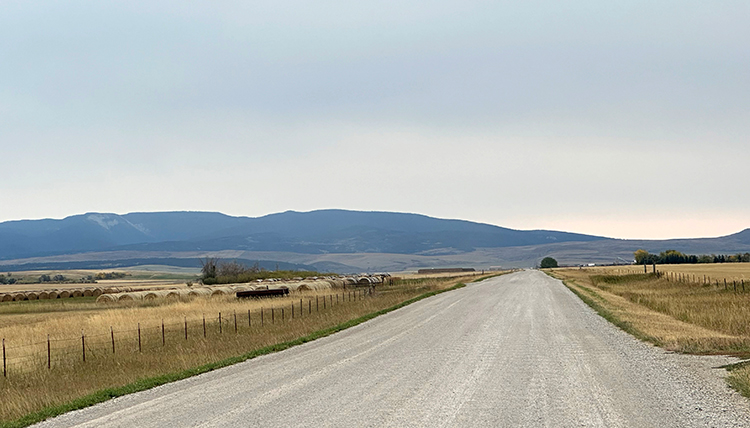
Fergus County, Montana
1930s-40: The Judith Mountains, the Little Snowy and Big Snowy Mountains, the many buttes and creeks, and Crystal Lake: all were home to a couple of love birds who built a new family from two, musicians who played in dance halls, a farmer and baker who created a lineage of people who would equally love the mountains, the sight of wheat in summer, the smells of fresh-baked goods and the floury residue of pastry dough in our hands.
Harold and Ferrel would later say they regretted leaving Montana. Their children would grow up with urges to be back in the mountains in the great West, and some of the grandchildren would feel that unmistakable urge, too. But this generation – my generation – also would be content with the memories made in MIssouri where Gramma and Grampa had a different two-story white house on a farm with some rolling hills and creekbeds and pastures for cows. It didn’t have that “big sky” Montana feel, but you could see the same moon.
And we still have pictures of Gramma in her glamorous poses and Grampa looking dapper. And stories – lots of stories – of years full of adventure, laughter, and connection.

And as I close out this short chapter of our story, I steal a phrase from Grampa’s 1932 letter:
“I’ll be seeing you in dream land.”
 wordsncoffee
awww Kate that was so neat, and so glad you were able to experience it with your dad and Aunt Sharon. Such a beautiful description of a family history.
LikeLiked by 1 person